Every framework in this series exists to answer one question: how do you get someone else to fight for your deal when you're not in the room to fight for it yourself. Finding Your Champion covers how to identify that person. Selling Through Curiosity covers how to uncover what they actually need. The Three Why's covers the case you build together. Champion Selling is the umbrella all three sit under, and the part that ties them together: what it actually takes to enable someone to carry your deal forward without you.
What is Champion Selling?
Champion Selling is the practice of identifying, developing, and enabling one person inside a buying organization to advocate for your solution internally, in meetings, emails, and hallway conversations you'll never see. The real selling in enterprise deals happens there, not in your demo.
What makes someone a real Champion, not a Coach?
This only works if the person you're enabling is a real Champion, not a Coach. Both are valuable, and you need both in a deal, but they play very different roles.
A real Champion has three specific ingredients, and all three need to be present.
Authority. They have the juice to get things done inside the organization. This doesn't have to mean a senior title, plenty of real Champions carry real weight without a VP badge, but it does mean people around them move when they push. If nothing happens when they ask for something, they're not your Champion yet, no matter how enthusiastic they are.
Influence. They can actually sell internally, and people listen to what they say. Authority gets things unstuck. Influence gets people to change their minds. A Champion needs both: the standing to move a decision and the credibility to shift how their peers and leadership think about the problem.
They sell on your behalf. This is the part that separates a Champion from a Coach. A real Champion takes action: they speak up in meetings you're not in, they advocate for the deal when a competitor's name comes up, they organize the introductions that bring more stakeholders to the table.
What is a Coach, and why do you need one?
A Coach has Influence, but typically no Authority, or they have some authority and choose not to flex it on your behalf. What a Coach gives you instead is guidance: they'll tell you how to navigate the deal, who actually holds sway in the org, and who you should be working to build into a Champion.
This makes a Coach genuinely valuable, just for a different job than a Champion does. A Champion sells for you when you're not in the room. A Coach helps you understand the room well enough to know who else needs to be in it. Deals with a strong Coach and no real Champion tend to stall, all insight, no internal advocate. Deals with a Champion and no Coach tend to move fast until they hit an internal obstacle nobody saw coming. You want both.
How do you build a Champion?
Building a Champion is its own sales process, and it starts before you know who your Champion will actually be.
You start by identifying Prospective Champions: people you believe carry the Authority and Influence to become a real Champion, based on what you know so far. That belief comes from two places, your own research (the account and title research covered in Finding Your Champion) and calling up and down the org once you're inside, asking who actually drives decisions on this initiative.
From there, the goal is converting each Prospective Champion into a Tested and Validated Champion: someone who has actually demonstrated Authority, Influence, and action on your behalf, not just potential for it. Every Prospective Champion you meet runs through a mini sales cycle of its own, discovery to understand their stake in the initiative, a case built around the Three Why's, and enough runway to watch whether they actually act on it.
Some Prospective Champions validate fast. Others take longer, or never validate, and turn out to be Coaches instead, genuinely useful, just not the person carrying the deal.
If you're unsure where someone actually stands, the Champion Confidence Scorer gives you a structured way to score it, rather than going on gut feel alone.
How do you track where everyone stands?
At any point in a deal, you need a working map of where every person you've met actually stands. A simple three-color system does the job, and it's worth sketching out against the actual org chart for the account you're working:
- Green: tested and validated Champion or Coach, in your camp
- Amber: Prospective Champion, sentiment unknown or still forming
- Red: anti-Champion, actively opposed to your approach, sometimes championing a competing solution of their own. Call this person what they are: the eel in the deal. They're dangerous precisely because they can look neutral right up until the moment they surface with an objection you didn't see coming
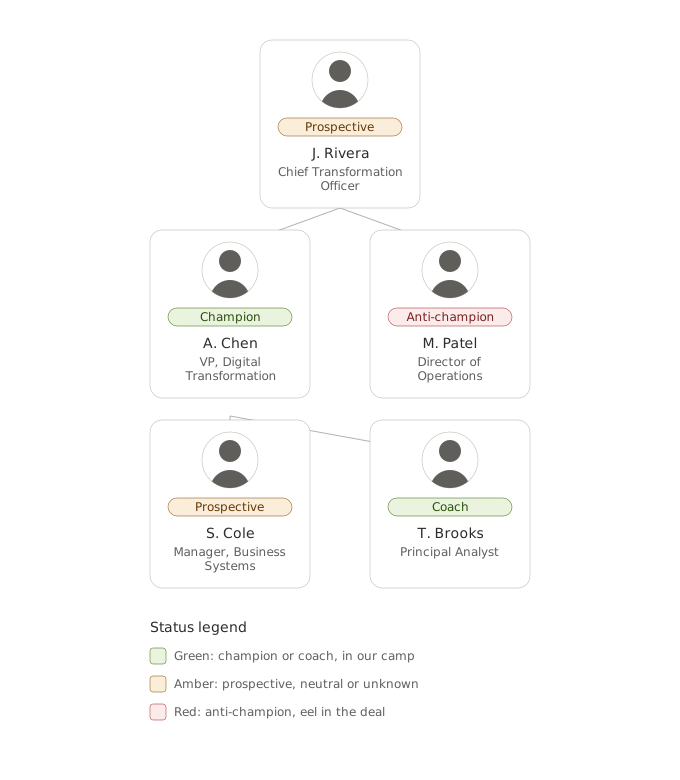
Update this map as the deal moves, not once at the start. Someone who reads Amber in week one might validate to Green after a strong conversation, or reveal themselves as an eel once a competitor enters the picture. The map is only useful if it reflects where things actually stand today, not where they stood when you first mapped the account.
What is a Champion Deck, and why should it look like theirs, not yours?
A Champion Deck is the artifact your Champion actually presents internally, and the best ones are co-authored, not handed over. You build it together, and it frequently carries their company's branding and their own voice rather than yours, because your Champion is the one standing up and presenting it, not you.
Think about what's actually happening: your Champion needs to walk into a room and make a case to people who've never spoken to you. A deck stamped with your company's logo reads as a vendor pitch that got forwarded along. A deck that looks like it was built by someone on the inside, using their language, their formatting conventions, their internal shorthand, reads as their own thinking. That difference changes how the room receives it.
This is where the Three Why's and the appendix material behind them, business case results, customer testimonials, an implementation plan with clear ownership, actually live. The Champion Deck is the container. The Three Why's are what goes inside it.
If you need a starting point for that material, the Executive Brief Wizard turns your inputs into a downloadable business case document your Champion can adapt into their own deck.
How close should you actually be with your Champion?
Close enough to text. That's a genuine signal worth watching for, not a throwaway line. A Champion relationship that only exists inside scheduled calls and formal email threads is a shallow one. The real ones move to something faster and more direct: a quick text to check on timing, a heads up before a meeting, a "how'd it go" the same afternoon.
That level of access is both a sign you've built a real relationship and a practical advantage. Deals move at the speed of the information you have, and a Champion who'll text you back in twenty minutes gives you a speed advantage over a rep who's waiting three days for a calendar slot to open up.
How the whole framework fits together
Champion Selling is a sequence, not one technique:
- Finding Your Champion: research the account, spot the titles that signal someone is chasing a real corporate initiative, and structure the first conversation to open the door.
- Selling Through Curiosity: use the 5 Magic Questions of Discovery to uncover the pain, the metrics, the decision criteria, and the Personal Win that tells you this person can become a real Champion.
- Build and track: treat each Prospective Champion as its own mini sales cycle, convert them to Tested and Validated where you can, and keep an honest Green/Amber/Red map of everyone else you meet along the way.
- The Three Why's: build the case, Why Anything, Why You, Why Now, that your Champion will actually carry into rooms you're not in.
- Enable and stay close: a co-authored Champion Deck, and a relationship close enough that you know what's happening before it becomes a problem.
Skip any one of these and the whole thing weakens. A Champion with Authority and Influence but no real case to carry is armed with nothing but goodwill. A perfect Three Why's case handed to a Prospective Champion who never validates goes nowhere. The framework only works end to end.
Frequently asked questions
What is Champion Selling in enterprise sales?
Champion Selling is the practice of enabling one person inside a buying organization, a real Champion, to advocate for your solution internally on your behalf. It rests on identifying the right person, uncovering their motivation through discovery, building a case they can defend, and equipping them with the tools to carry it forward without you in the room.
What's the difference between a Champion and a Coach?
A Champion has Authority, Influence, and a track record of taking action on your behalf, speaking up in meetings, advocating when a competitor comes up, bringing in other stakeholders. A Coach has Influence but typically no Authority, or doesn't use the authority they have for you, and instead helps by explaining how to navigate the deal and who to build into a Champion. Both roles matter, and most healthy deals have at least one of each.
What's the difference between a Prospective Champion and a Tested and Validated Champion?
A Prospective Champion is someone you believe has the Authority and Influence to become a real Champion, based on research or early conversations. A Tested and Validated Champion has actually demonstrated it, taking real action on your behalf, not just expressing support. Getting from one to the other is its own mini sales cycle for each person you meet.
What does "eel in the deal" mean?
It's a name for an anti-Champion: someone actively opposed to your approach, sometimes because they're championing a competing solution of their own. They're risky specifically because they can present as neutral or even friendly right up until they surface an objection that derails the deal, which is why tracking sentiment honestly matters more than tracking who's been pleasant on calls.
What is a Champion Deck?
A Champion Deck is the internal business case artifact a Champion presents to their own leadership, typically co-authored with the seller but built to reflect the Champion's own voice and often their company's branding, since the Champion is the one presenting it, not the vendor. It usually houses the Three Why's along with supporting appendix material like business case results and an implementation plan.